

Mawlana Mahmood Ali Shafaq Rampuri on Ilm al-Raml
In his renowned book “Ilm al-Raml”, Mawlana al-Hajj Mahmood Ali Shafaq Rampuri describes this sacred science as follows:
“Know that Ilm al-Raml is an extremely noble, authentic, and divinely transmitted knowledge passed down by the great saints and scholars. Some refer to it as a ‘Heavenly Science’ and consider it among the sciences of the prophets. Some scholars attribute it to Prophet Adam (علیہ السلام), others to Prophet Daniel (علیہ السلام), and some to Prophet Noah (علیہ السلام) or Prophet Idris (علیہ السلام). However, the reason for its divine revelation remains the same: whenever these prophets needed guidance about their offspring or specific life events, they prayed to Allah for knowledge that would reveal the unseen. In response, Angel Jibrael (علیہ السلام), by Allah’s command, descended and placed his four fingers in the sand, creating four dots. From these dots, the entire knowledge of Ilm al-Raml was revealed. Since the Arabic word ‘Raml’ means ‘sand’, and Angel Jibrael (علیہ السلام) first demonstrated this knowledge on sand, it became known as Ilm al-Raml (the Science of Sand).”
Abdul Raheem RInd’s Perspective from “Raheem al-Raml
Further research leads us to Abdul Raheem RInd (رحمتہ اللہ علیہ), who in his famous book “Raheem al-Raml”, describes Ilm al-Raml as follows:
Various spiritual texts confirm that this sacred knowledge was first revealed to Prophet Adam (علیہ السلام) through divine revelation. After him, it was inherited by Prophet Idris (علیہ السلام). Later, Imam Ali (کرم اللہ وجہہ الکریم) spoke about its significance, and Prophet Daniel (علیہ السلام) was the one who popularized its practical use. This is why most scholars associate Ilm al-Raml primarily with Prophet Daniel (علیہ السلام).
According to Scholars of Ilm-e-Raml, when Angel Jibrael (علیہ السلام) placed his four fingers in the sand, they formed four dots. The shapes created from these dots were called Abu al-Raml. The four dots were then divided based on the four elements (Arkan):
- Fire (Naar) – Eastern direction
- Air (Baad) – Western direction
- Water (Aab) – Northern direction
- Earth (Khak) – Southern direction
By further calculations and divine multiplications of these shapes, 16 figures were formed. Using these figures, one could predict the future conditions and destinies of people.
Ilm al-Raml – The Science of Geomancy
In English, Ilm al-Raml is known as Geomancy. Over time, this knowledge has evolved, incorporating new methods and refinements. Throughout history, scholars and experts have developed rules and techniques for practical application. However, a strict warning was always given:
✔ This knowledge should only be taught to worthy students.
✔ It should not be made accessible to just anyone.
This principle applies not only to Ilm al-Raml, but also to other esoteric sciences like Ilm al-Jafr, Ilm al-Adaad, and Ilm al-Naqoosh.
The Role of a Geomancer (Rammal)
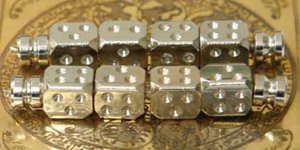 A practitioner of Ilm al-Raml is called a Rammal (Geomancer in English). The readings derived from Ilm al-Raml are often called “Faalnama”. Many books refer to this as “Geomancy Chart” (Geomantic Horoscope), but there is a distinction:
- Geomancy Chart (Geomantic Horoscope) is based on time, date, month, and planetary positions.
- Ilm al-Raml (Geomancy), however, relies on randomly casting dots or throwing a Geomancy Dice (قرعہ) to form specific patterns (Ashkaal), which are then interpreted for answers.
The Life Within Knowledge
Scholars and spiritual practitioners believe that knowledge itself has a living essence. When a person dedicates themselves to a field of study for a long time, its hidden aspects begin to reveal themselves.
This is also true for Ilm al-Huruf (The Science of Letters), Ilm al-Adaad (Numerology), and Ilm al-Jafr (Divine Letter Calculations). Though these may seem like theoretical sciences, when approached with pure intentions and strict adherence to rules, they lead to a deep spiritual connection. Over time, a practitioner’s subconscious mind begins to receive intuitive answers, and every question is met with a divinely inspired response.
It is important to remember that the knowledge of the unseen is known only to Allah جل جلالہ . These disciplines can only offer estimations; they cannot present absolute truths. Therefore, they should only be used to interpret hints and probabilities—nothing more. However, Allah جل جلالہ grants knowledge to whomever He wills, bestows mastery over that knowledge, and also grants the ability to delve into its depths and perceive its insights.