

Story behind loshu Grid
The history of the Lo Shu Grid (also known as the Lo shu Square) is deeply rooted in ancient Chinese mythology and is considered the oldest known normal magic square of order three.
Here is a summary of its history:
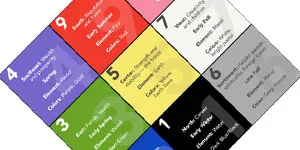 Mythical Origin (Circa 2200 BCE): The most famous account places its origin during the reign of the mythical Emperor Yu of the Xia dynasty, around 3000 to 2200 BCE. According to legend, a magical tortoise (or turtle) emerged from the Luo River (hence the name Lo Shu, meaning “Luo River Writing”). On its shell was a curious pattern of dots, which, when translated into numbers, formed a 3×3 grid.
Magic Square Property: The unique feature of this grid is that every row, every column, and both main diagonals sum up to the number 15. This perfect balance and symmetry were seen as a divine message and a symbol of cosmic order. The number 5 sits in the center.
438951276
- Philosophical and Cultural Significance: The Lo Shu is considered part of the ancient Chinese tradition of mathematics and divination, often paired with the Hetu (River Map). It is an important emblem in Feng Shui (Chinese geomancy), numerology, and the organization of the Bagua (Eight Trigrams). The numbers correspond to specific directions, elements, and concepts of life.
- Historical Documentation: While the legend places its discovery much earlier, the earliest ambiguous references to a “river map” are found in texts from around 650 BCE. Clear references to the Lo Shu as a magic square and explicit examples appear in texts from the Han Dynasty (202 BCE – 220 CE) and later, with explicit examples dating from as early as 570 CE.
In essence, the Lo Shu Grid is revered in Chinese culture as a fundamental diagram illustrating the harmony and relationship between numbers, space, time, and the elements of the cosmos.
Is lo Shu grid reliable?
The question of the Lo Shu Grid’s reliability depends entirely on the framework you use for evaluation—whether it’s based on empirical science or on metaphysical and philosophical tradition.
Here is a breakdown of its perceived reliability:
From a Scientific/Empirical Perspective
The Lo Shu Grid is generally not considered a reliable predictive or diagnostic tool by the scientific community.
- Lack of Empirical Evidence: There is no scientific or archaeological evidence to support the folklore of its origin (the magic turtle) or the claims that a person’s birth date, when mapped onto the grid, accurately predicts personality traits, life events, or a quantifiable balance of energy.
- Subjective Interpretation: The meanings assigned to numbers (e.g., 1 for leadership, 4 for stability) and the interpretation of missing or repeated numbers are considered arbitrary and lack a verifiable, mathematical, or psychological basis.
- Cognitive Biases: The reported “accuracy” by practitioners is often attributed to common psychological phenomena:
- Confirmation Bias: The tendency to remember information that confirms your existing beliefs about yourself while ignoring information that contradicts them.
- The Barnum Effect: The tendency to believe that vague, general personality descriptions (like those in horoscopes or numerology) are specifically tailored to them.
- No Validation Testing: Unlike validated psychological assessments, the Lo Shu Grid has not been subjected to rigorous, repeatable, and peer-reviewed testing to establish its predictive accuracy or reliability.
From a Metaphysical and Philosophical Perspective
The Lo Shu Grid is considered highly reliable and profound by practitioners of Chinese metaphysics, numerology, and Feng Shui.
- Symbol of Cosmic Order: Within this context, the grid is reliable because it is a perfect representation of harmony, balance, and the natural flow of energy (Qi). The fact that all lines (rows, columns, diagonals) add up to 15 is seen as a key to understanding the universe’s structure.
- Diagnostic Tool for Energy Balance: Practitioners believe that mapping a person’s birth date onto the grid reliably reveals their energy imbalances (missing numbers) and dominant strengths (repeated numbers).
- Foundation of Feng Shui: The grid is the foundational template for the Flying Star School of Feng Shui and the arrangement of the Bagua (Eight Trigrams). It is used to analyze a home’s or building’s energy flow and to determine auspicious placements for objects and directions.
- Tool for Self-Reflection: Even proponents who acknowledge its non-scientific nature find it to be a reliable and useful tool for self-awareness and personal growth, providing a structured framework to think about life challenges and character development.
Conclusion
If you are looking for a system with scientific reliability and empirical proof, the Lo Shu Grid is not the answer.
If you are open to metaphysical traditions and seeking a philosophical and intuitive tool for self-discovery, spiritual insight, or practical guidance within the framework of Chinese arts like Feng Shui, then practitioners consider it to be a powerful and reliable map of destiny and energy.